
A Neighborhood Born at a Turning Point
Loberg is one of those Arvada neighborhoods that can seem quietly ordinary at first glance: mature trees, comfortable homes, familiar streets, and easy access to Olde Town. But beneath that everyday character is a remarkable story. Loberg represents the moment when Arvada began moving beyond its identity as a small agricultural service town and started becoming the suburban community we recognize today.
The neighborhood lies north of central Arvada, generally east of Wadsworth Boulevard and around streets such as West 59th Avenue, West 60th Avenue, Secrest Drive, Robinson Way, Upham Street, and Newland Street. Its homes and blocks sit close to the historic heart of the city, making Loberg a living bridge between Arvada’s farming past and its postwar residential future.
The subdivision was approved during the 1940s, when Arvada was preparing for the changes that would follow World War II. In November 1945, the Loberg Subdivision became the first major addition to Arvada’s municipal area since the town’s incorporation in 1904. The 40-acre development was located north of Ralston Road and east of Wadsworth Avenue—land that had previously been part of the agricultural landscape surrounding town. ([rosap.ntl.bts.gov](https://rosap.ntl.bts.gov/view/dot/22497/dot_22497_DS1.pdf?utm_source=openai))
How Loberg Got Its Name
The neighborhood’s name comes from Dr. Loberg, a dentist who arrived in Arvada in 1913. His name was also attached to the Loberg Building, a prominent commercial structure constructed in 1929 at the southwest corner of Wadsworth Boulevard and Ralston Road. The building’s association with an established local professional reflects an older Arvada tradition: neighborhoods, businesses, and civic landmarks often carried the names of residents who helped shape the community.
The Loberg Building remains one of the most recognizable historic reminders of the name. Designed as a two-story yellow-brick commercial building, it features a distinctive central tower, red-tile roof, arched openings, and angled wings facing Wadsworth. Although the surrounding business district has changed considerably, the building still helps connect today’s Arvada with the community of the early twentieth century. ([maps.arvada.org](https://maps.arvada.org/Attachments/HistoricProperty/SurveyReport.pdf?utm_source=openai))
For longtime residents, “Loberg” is therefore more than a subdivision label. It is a name tied to medicine, commerce, and the civic confidence of a growing town.
The First Homes
The residential chapter of Loberg took shape just after the subdivision was approved. In 1947, developer George Clizbe built seven brick houses in the neighborhood. Each included five rooms and a garage—modest by modern standards, but highly desirable for families seeking a durable home in the early postwar years. ([maps.arvada.org](https://maps.arvada.org/Attachments/HistoricProperty/SurveyReport.pdf?utm_source=openai))
Those first houses arrived at an important moment. Across the country, returning veterans, young families, and expanding industries were fueling demand for new housing. Arvada had land available, a convenient connection to Denver, and a long-established town center. Loberg offered something especially appealing: new construction within walking distance or a short drive of Olde Town shops, schools, churches, and local services.
The neighborhood’s brick homes, practical floor plans, and relatively generous lots reflected the expectations of the era. They were built for everyday life—children playing outdoors, gardens in the back, and neighbors sharing news from front porches or sidewalks.
From Farm Country to Suburban Arvada
Loberg’s creation was part of a much larger transformation. Before World War II, Arvada was surrounded by farms and truck gardens. Local growers supplied produce to nearby communities, and the town functioned largely as a service center for the agricultural district.
That pattern began changing rapidly after 1945. Arvada leaders anticipated that some farms would give way to residential development, and Loberg became an early sign of that shift. The subdivision was followed by nearby developments such as Van Voorhis, while builder Chet Hoskinson began constructing hundreds of homes east of Independence Street in the early 1950s. By 1953, Hoskinson was responsible for most of Arvada’s new residential construction. ([maps.arvada.org](https://maps.arvada.org/Attachments/HistoricProperty/SurveyReport.pdf?utm_source=openai))
Loberg was small compared with later subdivisions, but its importance was symbolic. It established a model for growth: residential streets close to the historic commercial district, homes designed for middle-class families, and development that expanded Arvada without abandoning its original center.
Streets That Tell the Story
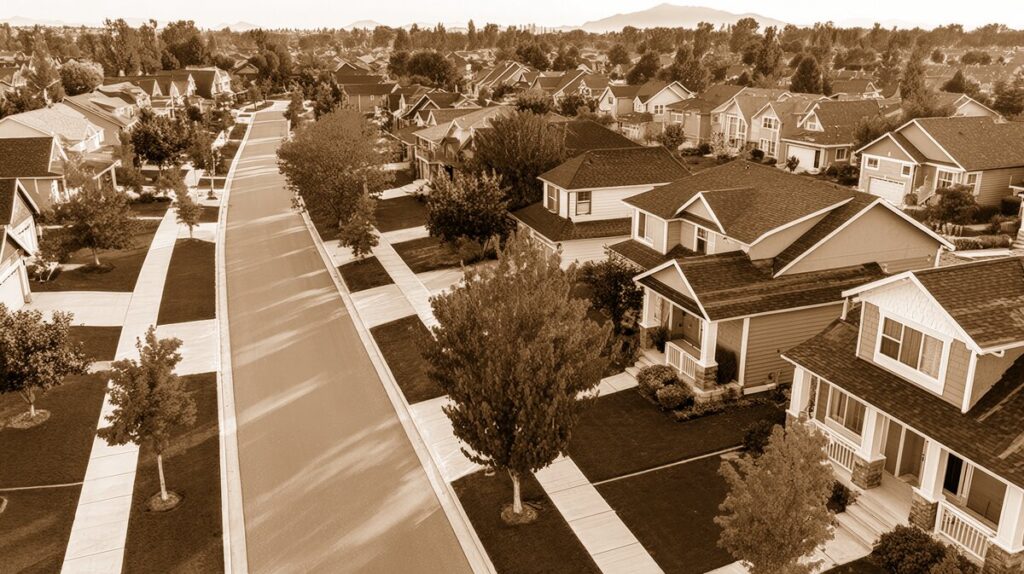
Walking through Loberg today, the street layout reveals the neighborhood’s age and purpose. West 59th and West 60th avenues, Secrest Drive, and Robinson Way carry a distinctly mid-century residential feel. Many properties have mature cottonwoods, established landscaping, detached garages, and additions that show how families adapted their homes over time.
The neighborhood also sits near several important Arvada corridors. Wadsworth Boulevard remains one of the city’s major north-south routes, while Ralston Road leads directly toward Olde Town and the civic center. Upham Street and nearby residential streets offer quieter connections to parks, schools, and local businesses.
Just to the south, Olde Town preserves many of Arvada’s best-known historic landmarks, including the Arvada Flour Mill Museum, Olde Town Plaza, the McIlvoy House, and the historic commercial buildings along Olde Wadsworth Boulevard. These places are not all within Loberg itself, but they form the cultural landscape that has always surrounded the neighborhood. ([visitarvada.org](https://www.visitarvada.org/oldetownarvada?utm_source=openai))
Parks, Community, and Everyday Heritage
Loberg’s heritage is not limited to buildings. It is also found in the public spaces and institutions that give central Arvada its sense of belonging.
Nearby parks provide places for children to play, neighbors to walk, and families to gather. Marge Roberts Park, originally called Holder Park, was purchased by the city in 1979 and renamed in 1990 for a local resident who led a neighborhood effort to redesign it. Its history reflects a familiar Arvada pattern: parks becoming stronger through volunteer involvement and local pride. ([arvadaco.gov](https://www.arvadaco.gov/521/Marge-Roberts-Park-Renovations?utm_source=openai))
The Ralston Creek corridor is another important part of the area’s identity. Today, the Ralston Creek Trail connects parks, open spaces, and historic places across Arvada. It follows a landscape associated with the city’s earliest settlement and with the 1850 gold discovery that helped launch the community’s history. ([arvadaco.gov](https://www.arvadaco.gov/558/Primary-Trails?utm_source=openai))
Schools, libraries, churches, and civic buildings have also helped keep central Arvada connected across generations. Residents of Loberg have traditionally benefited from being close to Olde Town’s events, local businesses, City Hall, cultural programs, and transportation routes.
A Neighborhood That Continues to Evolve
Over the decades, Loberg has changed without losing its basic character. Some original houses have been remodeled, expanded, or replaced. Properties have passed through several generations of owners, and contemporary additions now stand beside postwar brick homes. Building records still identify many parcels as part of the Loberg Subdivision, preserving the original name even as individual properties evolve. ([permits.arvada.org](https://permits.arvada.org/etrakit3/viewAttachment.aspx?ActivityNo=ADU25-00008&Group=PERMIT&key=AH%3A2510270323530989&utm_source=openai))
That balance is what makes Loberg special. It is neither a museum district nor a newly planned community. It is a lived-in neighborhood where history remains visible in the street grid, the mature trees, the older homes, and the nearby landmarks.
For longtime residents, Loberg’s appeal is easy to understand:
- It was one of Arvada’s first steps into postwar suburban growth.
- Its name honors a local dentist and civic figure.
- Its homes remain close to Olde Town’s historic heart.
- Its streets connect naturally to parks, trails, schools, and businesses.
- Its character comes from continuity—families, neighbors, and buildings adapting over time.
Loberg tells the story of Arvada in a particularly personal way. It began as farmland at the edge of a small town, became a pioneering residential subdivision, and matured into a welcoming neighborhood near one of the region’s most recognizable historic districts. Its heritage is found not only in official records, but in the ordinary pleasures of daily life: a walk along a tree-lined street, a glimpse of an old brick house, or an afternoon spent near Ralston Creek. That quiet continuity is what makes Loberg feel like home.